Failure Mode · FM-01 · Control Electronics
Sub-Zero Control Panel Blank After a Power Outage
Interior lights on, compressor silent, display gone dark after a storm flicker — the single most common no-cool call we run between Deerwood and Queen's Harbour.
A Sub-Zero® with a blank panel but working interior lights after a Deerwood outage almost always has a locked or surge-killed control board, not a dead sealed system. A two-minute breaker reset clears the cheap causes; a board still dark after that runs $550–$1,100 to replace, far below a built-in's value.
For Sub-Zero repair across Deerwood and the Jacksonville Southside, call (904) 893-3248 or book online.
Updated June 13, 2026
At a glance: what a dark panel actually means
Three quick answers cover most of what owners want to know before the technician arrives. Sub-Zero Repair Deerwood handles this on the Southside corridor — Deerwood, Pablo Creek Reserve, Glen Kernan, and Queen's Harbour in 32256, 32224, and 32225. Reach the direct line at (904) 893-3248, or use the external online booking page.
Why did the panel go blank after a brownout?
The board rarely dies during the outage itself. It dies at restoration, when JEA power snaps back 50–100% over nominal voltage and pushes that spike through the control electronics. The user-interface board takes the hit, locks out, and the display goes dark while the cabinet is still cold.
What does a board replacement cost?
Plan on $550–$1,100 for a documented diagnosis plus an OEM-spec board, installed and verified against the 38°F refrigerator and 0°F freezer set points. The board itself is usually $400–$700; the rest is metered diagnosis and labor.
Is the sealed system at risk?
Almost never from this failure. The compressor, evaporator, and refrigerant charge sit downstream of the board and stay healthy. That is why a blank-panel unit is a repair, not a replacement — you are restoring command, not rebuilding refrigeration.
Reset sequence before you call anyone
Run this first. It costs nothing and rules out the cheap causes that waste a service call. If the panel wakes during these steps, the board re-initialized and you are done.
- Check the obvious power path. Confirm the wall outlet has power and the kitchen GFCI or breaker has not tripped. Built-ins on a shared circuit with disposals and microwaves trip more than owners expect.
- Hard reset at the breaker. Switch the unit's dedicated breaker off for a full two minutes, then on. This forces the board to reboot from zero rather than resume a locked state.
- Wait one hour, not one minute. A recovering board lights the display and begins a cooling cycle within the hour. Judge it on the panel, not on the cabinet temperature.
- Document the state. Note whether lights work, whether the display shows anything (dashes, a partial readout, nothing), and whether the compressor ever cycles. That triage tells the technician which board to bring.
Panel still dark with lights working? That is the locked-board verdict. Read us the model and serial from the door-jamb rating plate at (904) 893-3248 and we bring the matching revision instead of ordering it after the visit.
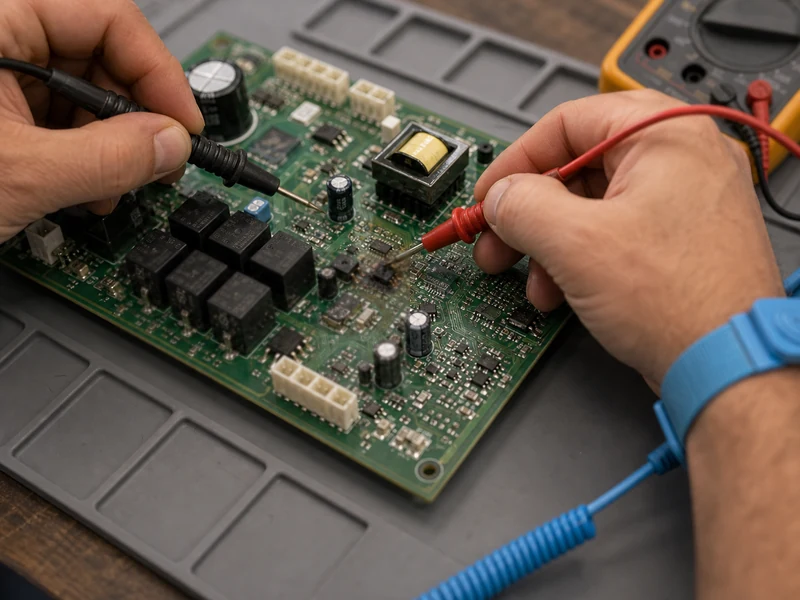
Symptom, first check, and the lane it falls in
| Symptom on the panel | First check | Cost lane |
|---|---|---|
| Fully blank, interior lights work | Two-minute breaker reset; if still dark, UI board is locked or failed | $550–$1,100 |
| Double dashes "--" displayed | EEPROM/board memory fault on 600 and early BI electronics | $550–$1,100 |
| Lights and display both dead | Power path: outlet, GFCI, breaker, plug behind the cabinet | $0–$250 |
| Panel works, one side won't cool (PRO 48) | Single sealed-system or relay output failure, not a full board death | $550–$2,000 |
| Display erratic, flickers, resets | Failing board or marginal connector; meter before swapping | $550–$1,100 |
If the readout is showing a coded fault rather than going blank, that is a different diagnosis — see the EC50 and EC40 code reference for excessive-run records, and the stopped ice maker checklist if only the ice system quit.
Reference data: why the Southside sees this so often
Northeast Florida records more cloud-to-ground lightning than any region in the country — 100-plus thunderstorm days a year — and the Southside grid feeding Deerwood, Pablo Creek Reserve, and Glen Kernan takes its share of flickers and restorations. Matthew in 2016 and Irma in 2017 each left parts of the corridor dark, and the wave of blank-panel calls that followed was the tell: the boards survived the dark and died at the snap-back. The BI line Sub-Zero built from 2008 to 2022 is especially prone to this brownout lock, and the corridor installed it heavily through the 2005–2015 remodel cycle.
- Restoration surge
- The voltage spike when grid power returns after an outage, commonly 50–100% over nominal. It is the actual killer of Sub-Zero boards — not the outage.
- Brownout lock
- A protective or damaged state where the user-interface board stops responding, leaving interior lights on and the display blank. Distinct from a dead appliance.
- EEPROM fault
- Corrupted board memory, classically shown as double dashes "--" on 600-series and early BI displays. The board must be replaced, not reset.
Queen's Harbour adds a wrinkle: brackish Intracoastal air corrodes board edge connectors and condenser components even though its central lagoon is freshwater, so a marginal connector there can finish failing during a surge that a drier kitchen would have survived.
Power-path problem or board problem? Tell them apart
A dark panel has two broad explanations, and they cost wildly different amounts. The cheap one is the power path — the unit simply is not getting clean voltage. The expensive one is the board itself. The split is decidable at the kitchen with a flashlight and the breaker, before any part is ordered.
| What you see | What it points to | Cost lane |
|---|---|---|
| Lights dead, display dead, nothing | No power: tripped GFCI/breaker, loose plug, or dead outlet | $0–$250 |
| Lights on, display dark, reset fails | Surge-locked or failed user-interface board | $550–$1,100 |
| Double dashes "--" after a brownout | Corrupted EEPROM; board must be replaced, not reset | $550–$1,100 |
| Display flickers, dims, or self-reboots | Marginal connector or a board mid-failure | $250–$1,100 |
| One side dark, the other normal (PRO 48) | Single-system board section, not a full unit death | $550–$2,000 |
The deciding move is the breaker reset. A board that re-initializes after two minutes off was never broken; a board that stays dark with the interior lights working has crossed from the cheap lane into the board lane. Everything else is detail the technician confirms with a meter.
Related symptoms a surge leaves behind
The blank panel is the loudest aftermath of a restoration surge, but it is not always the only one. The same voltage spike that locks the user-interface board can leave subtler marks elsewhere, and catching them on the same visit avoids a second trip.
- Ice maker quit, cabinet still cold. A surge can take the board's ice circuit or the inlet-valve solenoid while cooling continues. If only ice stopped, the stopped ice maker checklist isolates the valve from the board side.
- An EC50 or EC40 logged at the same time. A board recovering from a surge can re-log an old excessive-run record. The EC50 and EC40 reference separates a real airflow problem from a stale code.
- One PRO 48 compartment warm. On a dual-system unit a surge can disable a single side's board section; the working side masks it. The PRO 48 model page covers per-side isolation.
- The unit recovered, then failed again next storm. The board did not age out — it took a surge with nothing upstream to stop the next one. The surge protection note covers the panel arrester and point-of-use pairing that breaks the cycle.
Diagnostic case notes from the corridor
Educational diagnostic scenarios, not customer reviews.
Pablo Creek Reserve, BI-42SD. Owner reported the unit "dead" the morning after an afternoon storm; the gate log showed a brief outage. Interior lights worked, panel blank. A two-minute breaker reset did not wake it, which confirmed the UI board rather than the power path. We installed the matching board revision and a point-of-use surge device, then verified set points after the 24-hour stabilization window. Sealed system untouched.
Deerwood Country Club, 600-series. A legacy 650 in an original kitchen showed double dashes after a brownout — the EEPROM signature. Boards for that generation are scarce, so the diagnosis included confirming a rebuilt-board source from the exact serial revision before quoting. The owner kept a unit that would cost five figures to replace as a built-in.
Blank-panel questions from Southside owners
- How long do I wait after a power outage before deciding the board is dead?
- Give it a full restart cycle, not five minutes. Pull the unit at the breaker for two minutes, restore power, and let it run for an hour. A board that re-initializes will light the display and call for cooling in that window. If it stays dark with the interior lights working, the panel is locked or failed — waiting longer changes nothing but the temperature inside the cabinet.
- Why did the freezer stay cold but the display go blank?
- Interior lights and the display run off the user-interface board; cooling can keep coasting on residual cold while that board is locked. So a cold cabinet with a dark panel is not reassurance — it is the early window. Once the board cannot command a defrost or compressor cycle, the temperature climbs. Read the panel state, not the current cabinet temperature, to judge urgency.
- Is a blank panel ever a simple fix I can do myself?
- Sometimes. A tripped GFCI, a loose plug behind the cabinet, or a partially seated ribbon connector after a remodel can mimic board death. The two-minute breaker reset rules in or out the cheap causes. Past that, the diagnosis is electrical and the parts are model-specific Sub-Zero boards — guess-swapping a $400–$700 board on a hunch is how owners end up paying twice.
- Can a replacement board just fail in the next storm?
- It can if nothing upstream changes. The board did not die from age; it died from a restoration surge. We install the new board, then recommend dedicated surge protection — a whole-home arrester runs roughly $900–$1,200 installed and is cheaper than a second board. The surge-protection note covers options by panel type for Deerwood and Pablo Creek electrical setups.
- Do BI-series and PRO units behave the same way after an outage?
- The lockout symptom looks identical — lights on, panel dark — but the boards differ. PRO 48 units run dual sealed systems and a heavier control interface, so a surge can take down one side while the other keeps running, which reads as half a working refrigerator. We confirm the exact board revision from the serial plate before ordering, because Sub-Zero revised these electronics across multiple generations.
- How is a brownout lock different from an EEPROM failure?
- A brownout lock leaves the board electrically alive but frozen — interior lights on, display blank, no cooling command — and a clean two-minute breaker reset sometimes recovers it. An EEPROM failure has corrupted the chip that stores the unit's configuration, which on 600-series and early BI displays shows as double dashes "--". A reset will not fix that; the board has to be replaced. The reset is the test that tells the two apart.
- Should I throw out the food while the panel is dark?
- Not immediately. A built-in holds cold for hours once the door stays shut, and a brownout-locked board often keeps the cabinet near safe temperature through a same-day repair. Keep the doors closed, run the breaker reset, and judge by a thermometer in the refrigerator section: above 40°F for more than a couple of hours is the line for discarding perishables, not the dark display itself.
- My display works but flickers and resets on its own — same problem?
- Related, and worth catching early. A panel that flickers, dims, or reboots on its own is a board or connector starting to fail rather than one already locked — often a marginal ribbon connector after a remodel, or surge damage that has not finished the job. We meter the board outputs and the connector seating before swapping anything, because a reseated ribbon is far cheaper than a board if that is the real fault.
Service pages
Put a Southside Sub-Zero specialist on the schedule.