Failure Mode · FM-02 · Diagnostics
Sub-Zero EC50 and EC40 Codes: Excessive-Run Faults
The code that scares owners the most is usually the cheapest to fix — an excessive-run warning, not a compressor obituary.
On a Sub-Zero® in Deerwood or Pablo Creek Reserve, EC50 and EC40 are excessive-compressor-run warnings — EC50 the refrigerator side, EC40 the freezer side. The cause is a restricted condenser nine times out of ten, a $250–$550 cleaning. Only when airflow checks out does it climb toward $1,500–$3,000 sealed-system work.
For Sub-Zero repair across Deerwood and the Jacksonville Southside, call (904) 893-3248 or book online.
Updated June 13, 2026
At a glance: what the code is telling you
Three direct answers before the truck rolls. Sub-Zero Repair Deerwood diagnoses these codes across the Southside corridor — Deerwood, Pablo Creek Reserve, Glen Kernan, and Queen's Harbour, ZIPs 32256, 32224, and 32225. Direct line (904) 893-3248, plus an external online booking page.
What does EC50 mean?
EC50 means the refrigerator-side compressor ran longer than the control board's threshold. It is a warning about run time, not a diagnosis of a part. The board cannot see why the unit ran long — only that it did — so it raises the flag and waits for a human to find the restriction.
What does EC40 mean?
EC40 is the same excessive-run flag on the freezer-side system. On a single-compressor unit the two codes overlap heavily; on a dual-system PRO 48 they isolate the failure to one half of the cabinet, which saves diagnostic time.
What fixes it most often?
A condenser cleaning. The Sub-Zero field maxim holds here: the EC50 fix nine times out of ten starts with a vacuum cleaner. A coil packed with dust and pet hair cannot reject heat, so the compressor runs and runs trying to hit set point.
Cause, evidence, and the decision it drives
| Likely cause | Evidence on the visit | Decision & band |
|---|---|---|
| Dirty condenser coil | Visibly matted coil; high discharge temperature; airflow blocked | Clean — $250–$550 |
| Stalled condenser fan / triac | Fan not spinning; failed triac output metered on the board | Replace — $350–$900 |
| Torn or cooked door gasket | Warm air leak; dollar-bill seal test fails; visible deformation | Gasket — $300–$700 |
| Drifted thermistor | Sensor resistance disagrees with reference thermometer | Sensor — $550–$1,100 |
| Sealed-system leak / restriction | Clean condenser but partial frost on evaporator; gradual warming | Sealed — $1,500–$3,000 |
The order matters. We work this table top to bottom because the cheap causes are far more common and ruling them out is fast. A clean coil with the code still logging is what justifies opening the sealed system — not the code on its own.
Diagnostic sequence for an excessive-run code
- Read the log, not just the code. On BI and newer electronics we pull stored history — how often EC50 or EC40 fired tells us whether this is a slow choke or a sudden failure.
- Inspect and clean the condenser. Coil, fan, and the airflow path behind the grille. This alone clears the majority of Southside cases.
- Test the gasket seal. A door gasket cooked by Florida humidity leaks warm air and fakes a dozen other faults. Seal test, then inspect.
- Meter the sensors and fan. Thermistor resistance against a reference; condenser-fan amperage; triac output on the board.
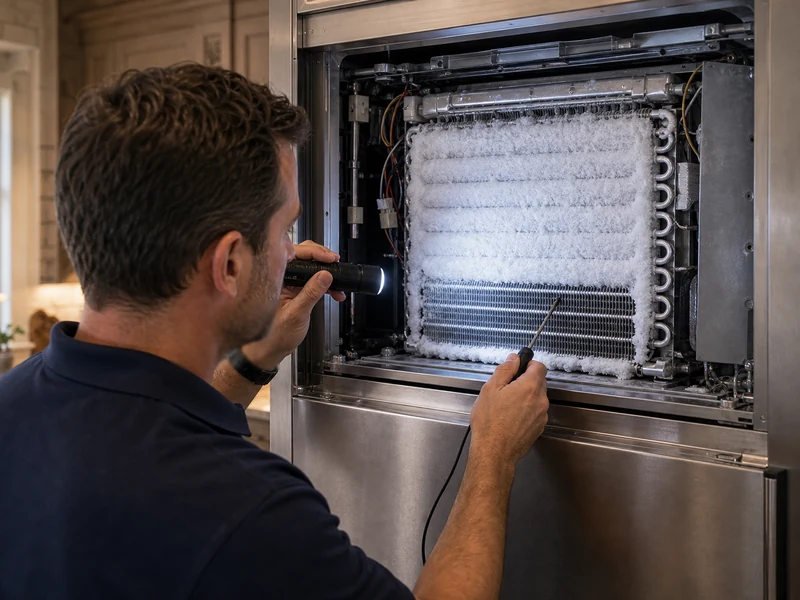
- Read the frost pattern. Only if the above checks out. Full, even evaporator frost clears the sealed system; frost on the first 4–8 inches indicts it.
- Quote in writing. Cause, component, and a fixed parts-and-labor figure — approved before further work.
Reference data: codes, generations, and local load
- EC50
- Excessive compressor run, refrigerator-side system. Warning, not a part diagnosis.
- EC40
- Excessive compressor run, freezer-side system. Isolates the side on dual-system units.
- Vacuum Condenser warning
- The earlier 600-series equivalent (1998–2002 boards) of the same excessive-run idea — a prompt to clean the condenser before the run time damages the compressor.
Two local facts shape how often we see these codes. First, the Southside's prime BI-series cohort — installed across the 2005–2015 build-and-remodel wave in Pablo Creek Reserve, Glen Kernan, and Hampton Park — is now deep enough in service life that condensers have years of dust on them and fans are starting to fail. Second, the cabinetry. Built-ins flush-set into tight millwork breathe through a narrow grille, and the dense kitchens common in 3,300–9,300 sq ft Pablo Creek homes choke a condenser faster than an open install would. Both push the same outcome: a coil that needs cleaning on the six-month end of Sub-Zero's schedule, not the twelve-month end.
Clean-coil long-run vs. a real sealed-system leak
The hardest call on this code is the last one: a unit that runs long after the condenser is clean. Two very different problems live there, separated by about $2,000. Reading them apart is a matter of pattern, not guesswork.
| Tell | Cleaning-lane cause | Sealed-system cause |
|---|---|---|
| Onset | Gradual, over years of dust load | Over weeks, cabinet creeping warm |
| Evaporator frost | Full, even coverage across the coil | Frost only on the first 4–8 inches |
| Condenser | Matted, fan slow or stalled | Already clean, fan spinning |
| Response to cleaning | Code clears and stays cleared | Code returns within days |
| Cost lane | $250–$550 | $1,500–$3,000 |
The partial frost line is the single most decisive tell. A coil that frosts only across its first few inches is starved of refrigerant — the classic leak signature — while a coil that frosts evenly end to end has a healthy charge and a different problem. On legacy boxes, even a sealed-system repair usually favors keeping the cabinet; the refrigerator repair page covers that repair-versus-replace math by model.
How urgent is the code, and what else to watch
Not every excessive-run code is an emergency, but a few pairings change the timeline. Use this to decide whether the call is "schedule it this week" or "today."
- Code alone, cabinet at 38°F. Schedule a condenser cleaning within a few days. The unit is working harder than it should, but food is safe and the compressor is not yet at risk.
- Code plus a cabinet creeping warm. Treat as urgent — this is the combination that drifts toward sealed-system work, and the not-cooling triage walks the warm unit from first check to cost lane.
- EC40 on a PRO 48 freezer side only. The single-side code isolates the fault to one of the two sealed systems; the PRO 48 model page covers per-side diagnosis so the working half stays untouched.
- Code returning right after a storm. A surge can re-log a stale record or damage the fan triac on the board. Pair it with the control-board reference if the display also acted up.
Diagnostic case notes from the corridor
Educational diagnostic scenarios, not customer reviews.
Glen Kernan, BI-36U. Recurring EC50 that the owner had cleared three times. The condenser behind the lower grille was matted with dust and dog hair; the fan spun but moved little air past the blockage. A full condenser cleaning and a fan check cleared the code, and it had not returned at the follow-up. Total ticket sat in the cleaning lane, not the compressor lane.
Pablo Creek Reserve, PRO 48. EC40 logging on the freezer side only. Because the PRO 48 runs independent sealed systems, the single-side code told us where to look without disturbing the refrigerator half. The condenser was clean; the freezer-side condenser fan triac on the board had failed. Replacing the triac-affected board section restored normal run cycles on that system alone.
Excessive-run code questions
- Does an EC50 code mean the compressor is about to fail?
- Not by itself. EC50 logs that the refrigerator-side compressor ran longer than the board expects, and nine times out of ten the cause is restricted condenser airflow — a clogged coil, a stalled condenser fan, or a gasket leaking warm air in. The compressor is usually fine. The fix is most often a thorough condenser cleaning, which sits in the $250–$550 lane, not a four-figure compressor job.
- What is the difference between EC50 and EC40?
- They flag the same problem on opposite sides of the cabinet. EC50 reports excessive run on the refrigerator-side system; EC40 reports it on the freezer side. On dual-system units like the PRO 48 the side matters, because each has its own compressor and sealed circuit. We read which code logged, and how often, to know which half of the unit to open first.
- I cleared the code and it came back. Why?
- Clearing a code clears the symptom, not the cause. If the condenser is still choked with dust, the unit will run long again and re-log the warning within days. Resetting it is useful only to confirm the fix worked after the underlying restriction is removed. A code that returns after a proper condenser service points deeper — to a sensor, a fan, or the sealed system.
- How often should the condenser be cleaned to prevent these codes?
- Sub-Zero specifies condenser cleaning every six to twelve months. On the Southside, build-up from Florida dust and pet dander stacks the high end of that schedule, and units tucked into tight cabinetry in Pablo Creek and Glen Kernan kitchens choke faster. A coil cleaned on schedule rarely throws EC50; a coil ignored for years almost always does.
- When is an excessive-run code actually a serious repair?
- When the condenser is clean, the fan spins, the gasket seals, and the unit still runs long. That pattern — paired with a partial frost line on the evaporator coil — points at a refrigerant leak or restriction in the sealed system, a $1,500–$3,000 repair. We rule out the cheap causes with a meter and a flashlight before we ever say the words "sealed system."
- Can I keep using the Sub-Zero while it shows EC50?
- For a short window, yes, but not as a habit. EC50 means the compressor is running far more than it should to hold temperature, which both raises the energy bill and ages the compressor faster. If the cabinet is still holding 38°F you have days, not weeks, to get the condenser cleaned. If the code is paired with a cabinet creeping warm, treat it as urgent — that combination is the one that drifts toward sealed-system territory.
- Does an EC50 on a 600-series unit mean the same thing as on a BI?
- The idea is the same, but the older units flag it differently. The pre-2002 600-series boards show a "Vacuum Condenser" warning rather than a numeric EC code — same root message, clean the condenser before the run time damages the compressor. BI and newer electronics log the EC50/EC40 numbers and store a history we can read on the visit. We confirm which generation the board is before interpreting the warning, since some 600-series boards are scarce or rebuilt-only.
- The condenser looks clean to me but the code keeps logging — now what?
- A coil can look clean at the grille and still be choked deeper in the fin pack, or the condenser fan can be spinning slowly enough to move little air. After a thorough cleaning, the next checks are the fan amperage and triac output, the door-gasket seal, and the thermistor reading. Only when all of those pass does a partial frost line on the evaporator move the diagnosis toward the sealed system and the $1,500–$3,000 lane.
Service pages
Put a Southside Sub-Zero specialist on the schedule.