Model Profile · BI-36U · Classic Built-In · 36"
Sub-Zero BI-36U Repair: The Corridor’s Most Common Box
If a single Sub-Zero shows up most on Southside work orders, it is the BI-36U over-under. Its faults are predictable, its parts are stocked, and its diagnosis starts with one fact about how it moves air.
The Sub-Zero BI-36U is an over-under built-in (2008–2022) with one sealed system feeding both compartments, so a warm fridge over a cold freezer is an airflow fault — fan, thermistor, or board — not a compressor. Sub-Zero Repair Deerwood services it across 32256, 32224, and 32225; most repairs run $250–$1,100. Call (904) 893-3248 or book online.
For Sub-Zero repair across Deerwood and the Jacksonville Southside, call (904) 893-3248 or book online.
Updated June 13, 2026 · Weekday window 07:00–19:00
How the BI-36U moves cold, and why that drives every diagnosis
The BI-36U runs a single sealed system — one compressor, one evaporator — and ducts freezer-cold air up into the refrigerator compartment. That architecture decides what a symptom means.
Because both compartments draw on the same cold source, a freezer that holds 0°F while the refrigerator climbs above 40°F is not a refrigeration failure. It is an air-delivery failure: the cold is being made, just not moved. The usual culprits, in order, are the evaporator fan motor, a drifted thermistor, and the damper that meters air between compartments. The Sub-Zero® control only cools when its sensors ask it to, so a lying thermistor leaves a warm cabinet with a perfectly healthy compressor.
Sub-Zero Repair Deerwood diagnoses the BI-36U board-level across Deerwood, Pablo Creek Reserve, and Glen Kernan — (904) 893-3248 reaches the direct line, and the external scheduling page logs your gate procedure at intake. The symptom-first version of this workup lives on the refrigerator repair page.
BI-36U symptom, first check, and cost lane
| Symptom | First on-site check | Cost lane |
|---|---|---|
| Warm fridge, freezer still 0°F | Evaporator fan amperage, thermistor, damper | $250–$1,100 |
| Long run times, EC50-class warnings | Condenser load, fan, airflow path | $250–$550 |
| Blank panel after an outage | Board outputs and supply before any parts | $550–$1,100 |
| Frost sheet on the freezer back wall | Defrost heater continuity, thermostat | $350–$700 |
| Ice maker cubes shrinking | Inlet valve fill volume, filter age | $250–$700 |
| Partial coil frost, slow warming both sides | Frost-pattern read, system pressures | $1,500–$3,000 |
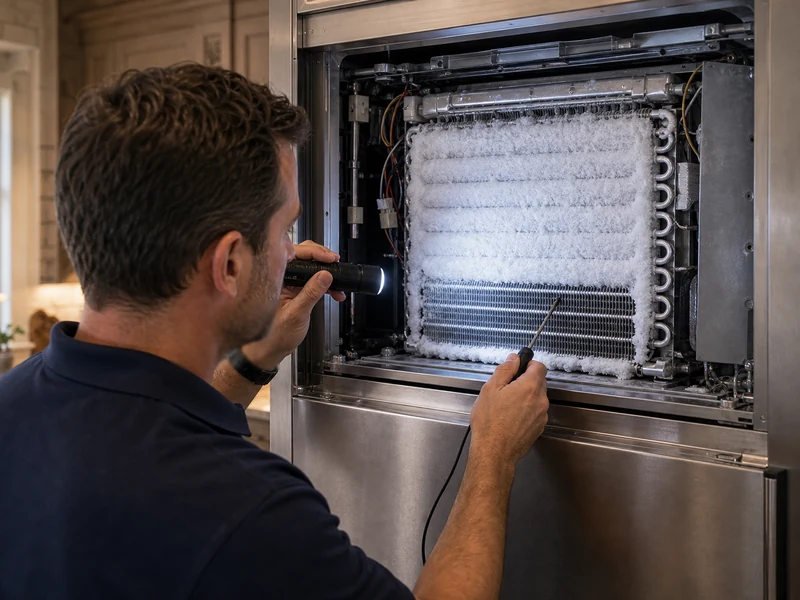
The single most important read on a BI-36U is the frost pattern. Full, even frost clears the sealed system and points the diagnosis at airflow and electronics; frost on only the first 4–8 inches of coil indicts a refrigerant leak — a different job at a different price.
The four parts that retire most BI-36U units
Across hundreds of these boxes the failure order barely changes. The evaporator fan motor leads — it runs constantly and wears out around year ten, taking the refrigerator's air delivery with it. The control board comes next and is usually storm-related, killed by a restoration surge rather than age. The defrost heater or thermostat is third, letting the freezer evaporator ice into armor. And the water inlet valve rounds out the list, scaled shut by Jacksonville's hard water until the ice maker starves.
Revision still matters even within one model. BI-series electronics changed over the 2008–2022 run, so we confirm the board generation from the serial before ordering, the same discipline the model index applies across every line. When the failure is the board specifically, the blank-panel procedure walks the reset-versus-replace decision, and the surge protection note covers keeping the replacement board alive through the next storm.
Where the Southside's BI-36U calls come from
Glen Kernan and Hampton Park are the steady source. Those streets built and remodeled between 1997 and 2015, which puts their BI-36U installs squarely in the ten-to-twenty year window where fan motors and boards retire on schedule. The Glen Kernan coverage notes track which build cohorts are reaching that mark.
Storm season writes the rest. Few regions take more cloud-to-ground lightning than this one, and storms cross the Southside on upward of a hundred days a year; the outages that followed Matthew in 2016 and Irma in 2017 left a wave of blank BI-36U panels behind them. A unit that never cooled right again after a storm deserves an electrical look before a refrigeration one. For the dispenser-equipped sibling that adds a through-door water circuit, see the BI-42SD profile.
The BI-36U warm-fridge diagnostic, step by step
Because one sealed system feeds both compartments, a warm-fridge BI-36U call follows a fixed order that rules airflow and electronics in or out before any sealed-system talk. This is the sequence at the cabinet.
- Confirm the freezer is cold. A freezer holding 0°F over a warm fridge confirms the compressor and sealed system are working — the cold is made, not moved.
- Meter the evaporator fan. Amperage on the freezer-bay fan; a stalled or slow fan is the single most common cause and stops air delivery to the fridge.
- Check the thermistor. Resistance against a reference thermometer — a drifted sensor leaves the board with no reason to cool a cabinet that is actually warm.
- Test the damper. The diffuser flap that meters air to the fridge can stick closed; verify travel before condemning a sensor.
- Read the frost pattern. Full, even coil frost clears the sealed system; frost on only the first 4–8 inches sends the diagnosis to refrigerant, a different job entirely.
BI-36U variants, years, and the revision notes that matter
The BI-36U badge covers a 2008–2022 run and a small family of related cabinets. Getting the exact variant and serial right is what keeps a single visit from becoming a wrong-part return trip, because door hardware and board generation differ across them.
| Variant | Configuration | What varies for parts |
|---|---|---|
| BI-36U / BI-36UG | Over-under, freezer drawer (G = glass-touch panel) | Control board generation by serial |
| BI-36UFD / BI-36UFDID | French-door variant, same platform | Door hardware, hinges, gasket set |
| Suffix /O (overlay) | Panel-ready overlay door | Door panel mounts, handle hardware |
| Suffix /S (stainless) | Factory stainless door | Door skin only; refrigeration identical |
The dispenser-equipped sibling that adds a whole water circuit is the BI-42SD, and the full installed base sits in the Sub-Zero model index. Read the plate to (904) 893-3248 and we pin the generation before dispatch.
BI-36U questions from corridor owners
- My BI-36U fridge is warm but the freezer is fine — what fails first?
- On a BI-36U one sealed system feeds both compartments, with freezer-cold air ducted up to the refrigerator. A warm fridge over a cold freezer therefore points at the air path: most often a stalled evaporator fan motor, a drifted thermistor reporting a false temperature, or a damper that is not opening. All three are mid-hundreds repairs, well short of any sealed-system work.
- How much does a BI-36U repair usually cost?
- Most BI-36U tickets close between $250 and $1,100. A condenser cleaning with fan service sits at the bottom; an evaporator fan motor or thermistor lands in the $250–$1,100 span; a surge-damaged control board runs $550–$1,100. Sealed-system or compressor work is the exception at $1,500–$3,000, and we confirm the frost pattern before ever quoting that lane.
- The display went blank after a storm — is my BI-36U dead?
- Almost certainly not. The BI-36U board rarely dies during an outage; it dies at restoration when voltage snaps back high. The classic result is interior lights on, compressor silent, panel blank — a locked or failed board on an otherwise healthy unit. Board replacement runs $550–$1,100, a fraction of replacing a built-in, and we recommend surge protection afterward.
- Does the BI-36U ice maker have the same hard-water problem as other Sub-Zeros?
- Yes. The BI-36U meters Jacksonville’s 14–28 grain water through a small inlet valve port that scales over time, so cubes shrink and eventually the fill stops. Because the BI-36U has no through-door dispenser, the water circuit is simpler than a BI-42SD’s — usually just the valve, filter, and module. We measure fill volume to confirm before replacing anything.
- Is a 15-year-old BI-36U worth repairing or should I replace it?
- Usually worth repairing. A BI-36U is a built-in scribed into cabinetry, so replacement often drags a cabinet job behind it, while the common failures — fan motors, sensors, boards — are mid-hundreds parts on a unit engineered to run 20-plus years. We only steer toward replacement when a sealed-system fault stacks on top of other aging components, and we put that math in writing.
- Is the BI-36U the same as a BI-36UFD, and does it change the repair?
- They are siblings, not twins. The BI-36U is the over-under built-in with a single freezer drawer below; the BI-36UFD is the french-door variant with a different door and hinge arrangement over the same refrigeration platform. The sealed system and most electronics carry across, but door hardware, gasket sets, and dispenser-area parts differ — so we confirm the exact suffix from the rating plate before ordering any door-side component.
- Where exactly is the BI-36U evaporator fan, and why does it fail around year ten?
- The evaporator fan sits behind the freezer rear panel, sharing the cabinet with the single evaporator that feeds both compartments. It runs nearly every minute the compressor does, so by the ten-to-fifteen-year mark the bearing is simply worn out from duty cycle, not abuse. When it slows or stalls, freezer-cold air stops reaching the refrigerator, and the fridge warms while the freezer stays at 0°F — the model's signature complaint.
- Does a BI-36U board change across the 2008–2022 run matter for my repair?
- Yes, and it is the most common reason a wrong part gets ordered. BI-series electronics were revised over the production run, so a control board correct for an early BI-36U may not match a later one. We read the serial to pin the board generation before sourcing, because a generic "BI board" order is a return trip. The serial also tells us whether your unit predates or follows specific valve and fan revisions.
Put a Southside Sub-Zero specialist on the schedule.