Technical Note · TN-01 · Electrical Protection
Surge Protection for a Sub-Zero in Lightning Country
The most expensive Sub-Zero failure on the Southside is also the most preventable. It is not a strike that kills the board — it is the snap-back when the lights come on.
Northeast Florida leads the country in lightning, and the restoration surge after an outage — power returning 50–100% over nominal — is what locks or kills Sub-Zero® control boards. A whole-home arrester runs roughly $900–$1,200 installed, less than a single board. This note covers layered protection for built-ins across the Deerwood corridor.
For Sub-Zero repair across Deerwood and the Jacksonville Southside, call (904) 893-3248 or book online.
Updated June 13, 2026
At a glance: the surge problem in one paragraph
Sub-Zero Repair Deerwood is an independent repair organization covering the Southside corridor — Deerwood, Pablo Creek Reserve, Glen Kernan, and Queen's Harbour in ZIPs 32256, 32224, and 32225. Direct line (904) 893-3248, with an external online booking page. This note exists because the same failure keeps arriving on our schedule and it is avoidable.
What actually damages the board?
Not the lightning strike, in most cases — the restoration surge. When the grid re-energizes after an outage, voltage can return 50–100% over nominal for a brief window. That transient is what the control board's electronics cannot absorb, so it locks out or fails outright while the compressor and sealed system stay healthy.
Why is the Southside so exposed?
The Southside absorbs more cloud-to-ground lightning than almost any metro in the country, with well over a hundred storm days each year. Every storm season pushes a wave of outages and restorations across the Deerwood-to-Queen's-Harbour grid — and a wave of blank-panel calls behind it.
What stops it?
Layered surge protection: a whole-home arrester at the panel plus a point-of-use device at the unit. Roughly $900–$1,200 installed for the panel arrester — cheaper than one board, and it guards the whole house.
How a restoration surge reaches the board
Picture the sequence a Pablo Creek kitchen sees a dozen times a summer. A storm cell crosses the JTB corridor, a line fault drops power, and the unit goes dark with everything else. Minutes or hours later the utility re-closes the circuit. For a short window the returning voltage overshoots — capacitive and inductive effects on a recovering line can push it well above the nominal 120/240V. The compressor does not care; it is a motor. The control board does, because it runs sensitive microelectronics and an EEPROM that holds the unit's configuration.
The damage shows up in two flavors. A brownout lock leaves the board alive but unresponsive — interior lights on, display blank, no cooling command — and sometimes a hard reset recovers it. An outright failure, or a corrupted EEPROM, shows as a dead panel or the double-dash "--" readout on 600-series and early BI electronics, and the board must be replaced. Either way the fix is electronic, not refrigeration, which is the whole reason these units are worth protecting rather than writing off. The full reset-versus-replace walkthrough lives on the blank control panel page.
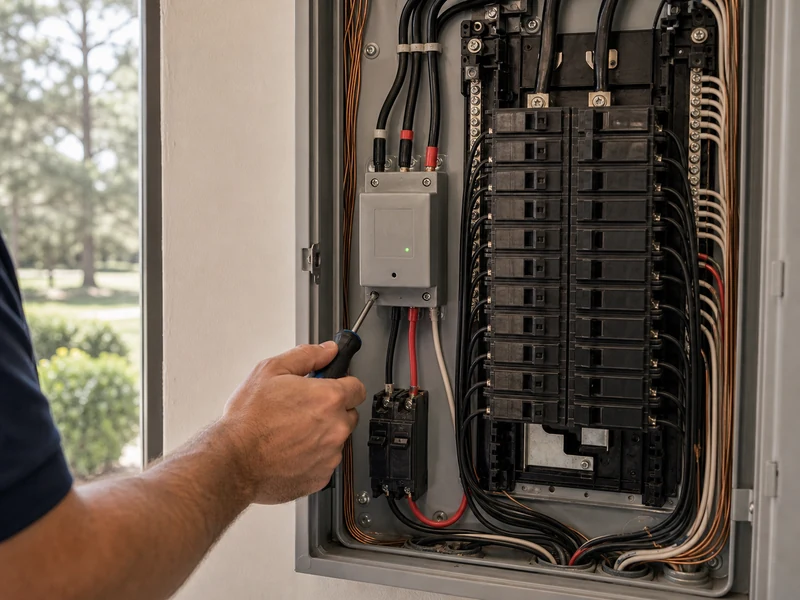
Protection layer, what it stops, and the cost lane
| Protection layer | What it stops | Cost lane |
|---|---|---|
| Whole-home arrester (panel) | Large transients arriving down the service from the grid | $900–$1,200 |
| Point-of-use device (outlet) | Residual spikes close to the unit; second stage | $40–$120 |
| Dedicated circuit verification | Nuisance trips and shared-load voltage dips | Electrician quote |
| Replacement board (no protection) | Nothing — this is the cost of skipping the above | $550–$1,100 |
| PRO 48 board hit, both sides | Worst case when an unprotected dual-system board fails | $1,100–$2,000+ |
The math is the argument. One arrester at panel cost is less than one board repair, and it protects every electronic load in the house. The point-of-use device is cheap insurance behind it. Read the table top to bottom and the bottom two rows are simply the price of having skipped the top two.
Reference data worth keeping
- Lightning load
- Florida draws more cloud-to-ground strikes than any other state; the Southside grid runs past a hundred storm days annually.
- Restoration surge
- Returning grid voltage commonly overshoots 50–100% over nominal — the actual cause of most board failures.
- Arrester cost
- Roughly $900–$1,200 installed for a quality panel-mounted whole-home unit.
- Board cost
- A Sub-Zero control board is $400–$700 as a part; $550–$1,100 diagnosed and installed.
- Storm record
- Matthew (2016) and Irma (2017) each darkened parts of the Southside, each followed by a wave of blank-panel calls.
Two corridor specifics sharpen the recommendation. Deerwood Country Club's oldest kitchens run on some of the Southside's oldest electrical, where a panel arrester does double duty across an aging service. And Queen's Harbour's brackish Intracoastal air corrodes board edge connectors, so a connector already compromised by salt fails more readily during a surge — which makes layered protection more important on the water, not less. Newer Pablo Creek and Tamaya homes often have better baseline electrical but the same lightning exposure, so the point-of-use stage still earns its place.
What we do, and where the electrician comes in
A clean division keeps everyone in their lane. Panel work — installing a whole-home arrester, verifying the dedicated circuit, correcting a shared load — is licensed electrical work, and we refer it out rather than touch a service panel. What we do is the appliance side: diagnose the surge-damaged board, install the correct OEM-spec revision confirmed from the serial plate, fit a point-of-use device at the unit, and verify the repair against the 38°F refrigerator and 0°F freezer set points after the 24-hour stabilization window.
The honest boundary applies here too. Equipment from the 2022-and-newer CL, DET, and DEC generation is usually under factory warranty and belongs with Factory Certified Service first; you should not pay out of pocket for a covered board. We take the out-of-warranty boards, the second opinions on units another company condemned, and the preventive work that keeps the next storm from repeating the bill. To put a protected repair on the calendar, the scheduling page takes about two minutes and logs gate access at the same time.
A storm-season readiness checklist
Hurricane season on the First Coast runs June through November, and the highest lightning density stacks into the summer afternoons. This is the short list worth running before the season's first cell crosses the JTB corridor — most of it is one-time setup that then protects every storm after.
| Task | When | Who |
|---|---|---|
| Install a panel whole-home arrester | One-time, before season | Licensed electrician |
| Fit a point-of-use device at the unit | One-time, before season | Us, at any service visit |
| Check the arrester status indicator | Start of season, after any strike | Electrician or homeowner |
| Verify the dedicated circuit and plug | Annually | Electrician |
| Clean the condenser; confirm set points | Every 6 months | Us, on a maintenance visit |
The last row is the quiet one: a unit working hard on a choked condenser is already stressed before a surge ever arrives. Pairing the six-month condenser service with layered surge protection covers both the slow failure and the sudden one. The EC50 and EC40 reference covers the airflow side of that equation.
Worked example: the cost of skipping protection
The argument for an arrester is easiest to see across the life of one unit. Take a BI-36U installed in a Glen Kernan kitchen, run through a typical fifteen-year stretch on the Southside grid — well over a hundred storm days a year, with several outages and restorations each season.
- Protected path. One panel arrester at roughly $1,050 installed, plus a point-of-use device near $80, fitted once. Across fifteen years the arrester may need one replacement after a heavy strike. Boards: zero surge failures expected. Rough fifteen-year surge cost: about $1,100–$2,200.
- Unprotected path. No upstream defense. A surge-killed board on this grid is a realistic event every several seasons — call it two board replacements over fifteen years at $550–$1,100 each, with the food loss and downtime each one carries. Rough fifteen-year surge cost: about $1,100–$2,200 in boards alone, before the aggravation.
The two columns land in the same range on paper — which is exactly the point. For roughly the same money, the protected path also guards the HVAC, the ovens, and every other electronic load in the house, and it spares the household two warm-cabinet emergencies. On a PRO 48, where a single board hit can disable an expensive dual-system unit, the math tilts harder toward protection. The aftermath of skipping it is documented on the blank control panel page.
Surge protection questions
- Does a Sub-Zero really need surge protection in Jacksonville?
- On this grid, yes. Northeast Florida records more cloud-to-ground lightning than any region in the country — 100-plus thunderstorm days a year — and the killer is not the strike but the restoration surge when power returns 50–100% over nominal. That spike is exactly what locks or destroys Sub-Zero control boards. A board is a $400–$700 part before labor; an arrester costs less and protects the whole house.
- Whole-home arrester or a plug-in strip behind the fridge?
- Both, in layers. A whole-home arrester at the panel clamps the large transients that come down the service from the grid, which is where restoration surges originate. A point-of-use device adds a second stage close to the unit. For a built-in worth five figures, the layered approach is the standard recommendation; a plug-in strip alone is thin protection against a service-level event.
- How much does whole-home surge protection cost installed?
- Plan on roughly $900–$1,200 installed by a licensed electrician for a quality panel-mounted arrester. That is meaningfully less than one Sub-Zero board plus diagnosis and labor, and it protects every electronic load in the house — HVAC, ovens, the rest. We do not perform panel electrical work ourselves; we flag the need and verify the appliance side after.
- My board already failed in a storm — does protection still help?
- It helps the next board. The board did not die of age; it died of a surge, so replacing it without addressing the cause invites a repeat. After we install the new board we recommend a point-of-use device immediately and a panel arrester through your electrician. The pairing is why a properly protected replacement tends to outlast the original.
- Do PRO 48 and BI units need different protection?
- The protection is the same; the stakes differ. A PRO 48 carries a heavier control interface and two sealed systems, so a board hit can disable one or both sides of an expensive unit. BI built-ins share the brownout-lock vulnerability. Either way the defense is upstream — at the panel and at the outlet — not inside the appliance.
- Does brackish or salt air change the surge risk?
- It compounds it. In communities like Queen’s Harbour, brackish Intracoastal air corrodes board edge connectors over time. A connector already weakened by corrosion fails more readily during a surge that a clean board might shrug off. So coastal-air kitchens get the strongest argument for layered protection, not the weakest.
- Should I unplug the Sub-Zero before a forecast storm?
- It is not practical and rarely necessary. A built-in is hard to reach behind cabinetry, and pulling power risks food loss and a stabilization cycle for a storm that may only brush by. The better answer is permanent: a panel arrester and a point-of-use device stay in place around the clock, so protection does not depend on catching a forecast. If you do lose power, the risk is the restoration surge when it returns, which the layered devices are there to clamp.
- How long does a surge arrester last, and does it need replacing after a hit?
- A quality panel arrester is rated for years of normal service, but its protective components degrade with each large transient they absorb. Many have a status indicator that signals when the unit has taken enough hits to need replacement. After a major strike or a string of close ones, it is worth having the electrician verify the arrester still protects — a spent device looks fine but no longer clamps, leaving the next restoration surge a clear path to the board.
- Will a generator or whole-home battery protect the Sub-Zero from surges?
- It addresses a different problem. A standby generator or battery keeps the unit running through an outage, which prevents the warm-cabinet scramble, but the transfer back to grid power can itself produce a switching transient. Backup power and surge protection are complementary, not interchangeable: the generator keeps food cold during the dark, and the arrester guards the board when grid voltage returns. Lightning country wants both layers.
Service pages
Put a Southside Sub-Zero specialist on the schedule.