Service Reference · SVC-05 · Rev. June 13, 2026
Sub-Zero Wine Cooler Repair Across the Southside
Wine storage fails quietly — a half-degree of drift, a film of frost, a sweating door — and the bottles pay for it long before the owner notices. Diagnosis here is about humidity and sensors, not horsepower.
Most Sub-Zero wine cooler faults on the Southside are dual-zone thermistor drift, evaporator icing, or humidity-driven seal failures — not compressor deaths. Sub-Zero Repair Deerwood services wine storage in 32256, 32224, and 32225 weekdays 07:00–19:00; typical repairs run $300–$950. Call (904) 893-3248 or book the external scheduling page.
For Sub-Zero repair across Deerwood and the Jacksonville Southside, call (904) 893-3248 or book online.
Updated June 13, 2026 · Coverage 32256 · 32224 · 32225
What is dual-zone drift, and why does it dominate wine tickets?
Dual-zone drift is when one climate of a two-temperature wine cabinet slowly leaves its set point while the other holds — the single most common Sub-Zero® wine complaint we run on the corridor.
A dual-zone unit keeps reds near 55°F and whites closer to 45°F using two thermistors and a damper that meters cold air between compartments. Thermistors are the weak link: they drift out of calibration with age and report a temperature the cabinet does not actually hold, so the control either over-cools one zone or never cools it enough. The damper can also stick, which strands the cold air on one side. Both are inexpensive next to the bottles they protect.
Sub-Zero Repair Deerwood diagnoses wine storage across Deerwood, Pablo Creek Reserve, and Glen Kernan — the direct line is (904) 893-3248, and the external scheduling page logs your community and gate procedure at intake. The same dual-zone logic appears on the combo cabinets covered in the undercounter service reference.
Wine symptoms, first checks, and cost lanes
| Observed symptom | First on-site check | Cost lane |
|---|---|---|
| One zone warm, the other correct | Thermistor resistance, damper travel | $300–$650 |
| Frost or ice at the rear wall | Door gasket seal, condensate path, sensor read | $300–$700 |
| Glass door sweating, long run times | Condenser load, gasket, evaporation tray | $300–$650 |
| Both zones warm together | Condenser, fan, board output, frost pattern | $550–$1,100 |
| Buzz or rattle, temperatures fine | Fan bearing, panel resonance, mounts | $300–$550 |
| Partial coil frost, slow warming | Frost-pattern read, system pressures | $1,500–$2,000 |
A wine unit that warmed across both zones right after a storm deserves an electrical look first, not a refrigeration one — that sequence is on the post-outage panel page.
Humidity is the wine cabinet's quiet enemy
Year-round Jacksonville humidity does two things to wine storage at once. It hardens and warps the door gasket — especially on glass-door units that radiate more heat — so humid air bleeds in and frosts the evaporator. And it loads the condensate system, because the moisture the unit pulls from that infiltrating air has to evaporate somewhere. When the evaporation tray or its drain backs up, water shows up at the base of the cabinet and gets mistaken for a leak.
Placement makes it better or worse. A climate-controlled butler pantry is the easy case; a garage or a covered outdoor bar is the hard one, where summer heat forces the compressor to run nearly continuously. We check gasket seal, condenser cleanliness, and the evaporation path on every visit before reaching for a sensor, because half of what looks like a control fault is really an environment the unit cannot win. The same airflow strain underlies the codes explained in the excessive-run code reference.
Where the corridor's wine calls originate
Pablo Creek Reserve generates the most wine work, and it is a function of the houses. Homes of 3,300 to 9,300 square feet behind the attended San Pablo Road gate routinely spec a wine column or two beside the primary refrigeration, and those units are now crossing the ten-year line where thermistors drift and gaskets give up. Route and gate logistics for that community are kept in the Pablo Creek Reserve coverage notes.
Deerwood Country Club supplies the other vein — older wine rooms in kitchens that have been remodeled across three generations, where a legacy 424 or 427 unit from the early 2000s still anchors a built-in rack. Those are exactly the units that reward repair over replacement, since dropping a new column into original cabinetry usually means a cabinet job too. When the equipment in question is a standard undercounter rather than a wine cabinet, the UC-24 service reference covers it.
The storage targets we verify against
A wine fault is measured against what the cabinet is supposed to hold, so a diagnosis starts from numbers. These are the targets a dual-zone Sub-Zero is built around, and the readings that move a complaint from normal cycling to a repair.
| Parameter | Healthy target | When it is a fault |
|---|---|---|
| Red-wine zone | ~55°F | 5°F+ drift or never reaching set point |
| White-wine zone | ~45°F | Over-cooling toward freezing, or warm drift |
| Relative humidity | 50–70% | Dry corks, label mold, condensate pooling |
| Zone-to-zone spread (dual) | ~10°F | Zones converge or one will not separate |
| Evaporator frost | Light, even, self-clearing | Spreading rear-wall ice, rising run time |
Stabilization applies here too: after a thermistor or damper repair a wine cabinet needs about 24 hours to settle, so we set the targets, log them, and ask owners to recheck the next day rather than judging an hour after the panel is touched.
How a wine storage diagnosis runs on site
Wine work rewards patience over parts. Because the cabinet drifts slowly and the cost of a wrong guess is a damaged cellar, the sequence below front-loads the cheap, environmental checks before any sensor or sealed-system conversation.
- Read both zones. Each zone metered against a reference thermometer, set points confirmed, and the zone-to-zone spread compared to spec.
- Test the seal. Paper-pull the door gasket at several points, especially the top edge on glass-door units that radiate more heat.
- Trace the condensate path. Confirm the evaporation tray and its drain are clear, because backed-up moisture mimics a leak and frosts the coil.
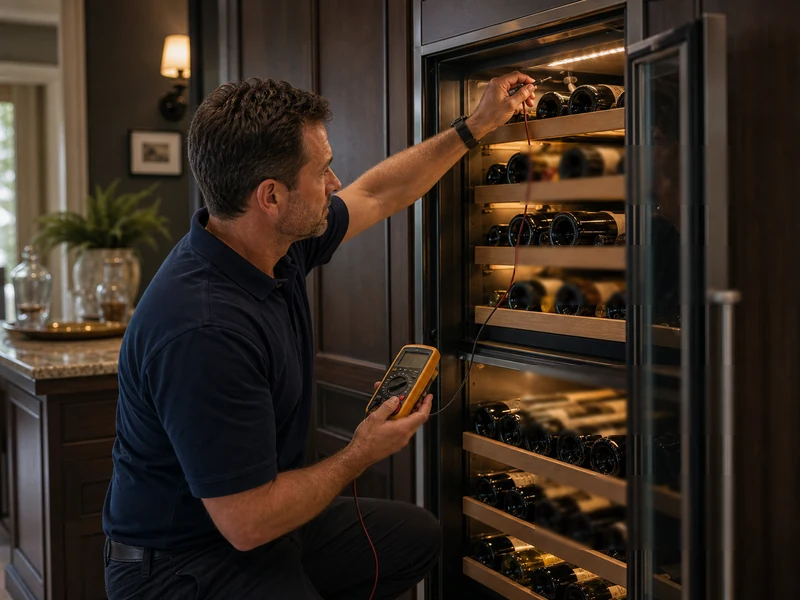
- Meter the sensors and damper. Thermistor resistance and damper travel checked before any control part is named — a stuck damper strands the cold.
- Quote, then verify. A written figure precedes the work, and the repaired cabinet is left to stabilize with logged targets for an owner recheck.
When the equipment in question is a combo undercounter rather than a dedicated wine cabinet, the same dual-zone sensor logic carries to the UC-24 service reference, and a unit that warmed across both zones after a storm starts on the post-outage panel page.
Wine storage questions from corridor owners
- One zone holds temperature and the other drifts — is the whole unit failing?
- No, and that split is good news. A dual-zone Sub-Zero wine unit runs separate thermistors and a damper for each climate, so one drifting zone usually means a single drifted sensor or a stuck damper, not a sealed-system problem. We meter each thermistor against a reference and watch damper travel before quoting; most single-zone faults close in the $300–$650 band.
- There is ice forming at the back of the wine cabinet — should I be worried?
- Worth a look, not a panic. Light evaporator icing in a wine unit usually traces to a tired door gasket letting humid Florida air in, a thermistor calling for more cooling than the cabinet needs, or a blocked condensate path. Left alone the ice spreads and run times climb. Caught early it is a gasket or sensor job, well under the cost of any sealed-system work.
- Why does my garage wine unit sweat and run constantly in summer?
- Ambient heat and humidity. A wine cabinet in a Jacksonville garage that touches 95°F is fighting a load it was never sized for, so the compressor runs long and the glass door beads with condensation. We confirm the gasket seals, clean the condenser, verify the condensate evaporation tray, and have a frank conversation about whether the location suits the unit before throwing parts at the symptom.
- Do you service the older 424 and 427 wine units as well as newer columns?
- Yes. The legacy 400-series — 424G, 427G and their variants from 1999 to 2016 — still runs in plenty of Deerwood and Queen’s Harbour wine rooms, alongside newer IW and BW columns. We confirm the exact model from the rating plate first, because Sub-Zero revised wine-unit parts repeatedly and a thermistor or damper for one generation will not serve another.
- Is a humming or buzzing wine unit a compressor warning?
- Usually not. The most common buzz sources are a condenser fan with a worn bearing, a loosened panel resonating, or a fill or recirculation component on combo cabinets. We isolate the noise by location and load before considering the compressor, which on wine units rarely fails first. A clear written finding precedes any sealed-system quote.
- What temperature should a Sub-Zero wine unit actually hold, and how far off is a problem?
- Reds sit best near 55°F and whites closer to 45°F, which is why dual-zone cabinets exist. A drift of two to three degrees is within normal cycling; a zone wandering five degrees or more off its set point, or one that will not reach set point at all, is a thermistor or damper fault worth a visit. We meter each sensor against a reference thermometer rather than trusting the panel, since a drifted thermistor is precisely the part that lies.
- Does a wine cooler need a humidity level, or just a temperature?
- Both matter for long-term storage. Corked bottles keep best around 50 to 70 percent relative humidity so the cork stays sealed; too dry and corks shrink, too wet and labels mold. Sub-Zero wine units manage this passively, but a tired door gasket or a backed-up condensate path throws it off — which is one more reason a sweating door or rear-wall frost is worth addressing before it reaches the bottles.
- My UV-glass wine door looks fine but the top shelves are warming — related?
- It can be. The UV-tinted glass blocks light but still radiates more heat than a solid panel, and the top of the cabinet runs warmest, so a marginal gasket or a leaning install shows up there first. We check the seal along the top edge, confirm the unit is level so the door seats evenly, and verify the upper-zone thermistor before assuming a refrigeration fault. The fix is usually a seal or alignment job, not the glass.
Put a Southside Sub-Zero specialist on the schedule.