Failure Mode · FM-03 · Ice System
Sub-Zero Ice Maker Stopped Working: What Failed First
A bin that went from full to empty over a few weeks is rarely a dead ice maker. It is usually the water path quietly closing on Jacksonville's hard supply.
When a Sub-Zero® ice maker stops in Deerwood or Glen Kernan, the cause is most often a scale-choked inlet valve — JEA water runs 14–28 grains hard. Rule out freezer temperature first, then filter age, fill tube, valve, and module. Valve and module work runs $250–$700; the freezer side is separate.
For Sub-Zero repair across Deerwood and the Jacksonville Southside, call (904) 893-3248 or book online.
Updated June 13, 2026
At a glance: the most likely culprits
Three answers up front. Sub-Zero Repair Deerwood services stopped ice makers across the Southside corridor — Deerwood, Pablo Creek Reserve, Glen Kernan, and Queen's Harbour in ZIPs 32256, 32224, and 32225. Direct line (904) 893-3248, with an external online booking page.
What stops a Sub-Zero ice maker most often here?
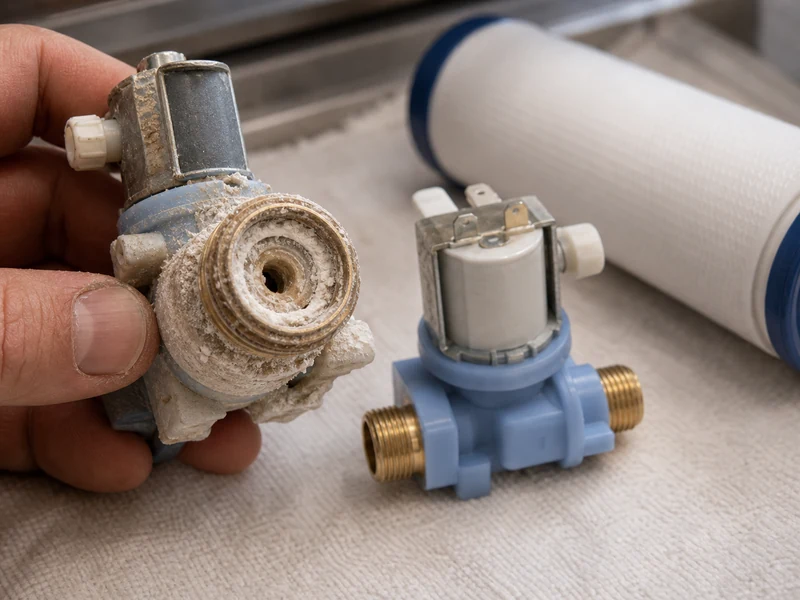
A water inlet valve restricted by scale. On 14–28 grain water the valve port narrows over months until the fill is too small to harvest. It is a wear part on this supply, and it is the first thing measured, not the first thing replaced.
What should I rule out before assuming a broken part?
Freezer temperature, the shutoff arm or optical sensor, and the filter date. A warm compartment, a bin pressing the arm, or a saturated filter each stop production while every part is healthy — and each is free or cheap to correct.
What does the repair cost?
Valve and module repairs sit at $250–$700. If the diagnosis points instead to the freezer's defrost or temperature side, that work is specified separately and priced on its own.
Owner checklist before the visit
Run these five checks first. Several resolve the problem outright, and the rest tell the technician which part to bring.
- Confirm the freezer temperature. The compartment must hold near 0°F. Production stalls in a warm freezer no matter how healthy the ice maker is.
- Check the shutoff arm or sensor. Wire arm down, or the optical sensor unblocked. A bin shoved against the arm reads as full and pauses harvest.
- Inspect the fill tube. Look for an ice plug in the tube — the hard-water classic. A slow fill freezes the last of the water and blocks the next cycle.
- Read the filter date. On JEA water the filter is a six-month item. A saturated cartridge slows the fill and accelerates valve scaling.
- Note the pattern. Sudden stop, or cubes that shrank for months first? Gradual shrink points at scale; a sudden stop points at the valve solenoid, module, or board.
Read us the model and serial from the door-jamb plate at (904) 893-3248 and we load the matching valve and module before dispatch.
Symptom, first check, and cost lane
| Symptom | First check | Cost lane |
|---|---|---|
| Cubes shrank for months, then stopped | Inlet valve scale and filter date; measure fill volume | $250–$550 |
| Stopped suddenly, freezer still cold | Valve solenoid, frozen fill tube, or module stall | $250–$700 |
| Water at the dispenser, no cubes | Module harvest motor or board ice circuit | $350–$700 |
| No ice and freezer is warm | Freezer-side defrost or sealed system, not the ice maker | $350–$3,000 |
| Bin full but everything looks fine | Shutoff arm or optical sensor reading "full" | $0–$250 |
If the bottom row applies — no ice because the freezer itself is warm — start with freezer-side defrost service instead, and check the EC40 excessive-run reference if a code is logging.
Reference data: water, valves, and bin math
- Water hardness
- JEA supply across the Southside runs 14–28 grains per gallon — "very hard," among the highest in Florida from the limestone Floridan aquifer.
- Filter interval
- Six months on this supply, not the twelve most owners carry over from softer markets. We date-label every filter we install.
- Fill verification
- Water delivered per cycle, measured on the visit. A short fill confirms a scaled valve; restoring fill volume restores cube size.
The corridor's specifics sharpen this. Some older Mandarin-adjacent and riverfront properties historically ran private wells, but inside the gated Southside the supply is JEA municipal water, so hardness — not iron staining — is the dominant ice-system enemy here. Queen's Harbour and Pablo Creek kitchens on that water see inlet valves scale on a predictable curve, which is why we treat the valve and filter as a paired replacement rather than swapping one and leaving the other to clog its successor.
No fill or no harvest? The fork that splits the diagnosis
Every stopped ice maker lands on one side of a single question: did water reach the tray? Answer it and the whole search narrows. A unit that never fills is a water-path problem; a unit that fills but never drops cubes is a harvest problem, and the two share almost no parts.
| Branch | What it looks like | Likely part & band |
|---|---|---|
| No water reaches the tray | Dry tray, possible ice plug in the fill tube | Scaled inlet valve / filter — $250–$550 |
| Short fill, undersized cubes | Cubes shrank for months before stopping | Valve port restriction — $250–$550 |
| Normal fill, no cubes drop | Water in the tray, tray never ejects | Module / harvest motor — $350–$700 |
| Fill and harvest both dead | No activity at all, freezer cold | Board ice circuit — $350–$700 |
| No ice, freezer warm | Whole compartment above 0°F | Defrost / sealed system — $350–$3,000 |
The bottom row is the trap. When the freezer itself is warm, no ice-system part is at fault and the real job is on the cold side — start with freezer-side defrost service and check the EC40 excessive-run reference if a code is logging alongside the warm cabinet.
The ice-system wear list on Southside water
On Southside water the ice-system wear list is short and predictable. These are the parts that come off the truck most often on a stopped-ice call, each tied to a local cause rather than a manufacturing flaw.
- Water inlet valve. The port and screen scale shut on 14–28 grain JEA water, narrowing the fill cycle by cycle. On this supply the valve is a wear part, not a defect — we replace it with the filter as a pair so a fresh valve is not fed by an old cartridge.
- Water filter. A six-month item here, not the twelve most owners carry over from softer markets. A saturated cartridge slows the fill and pushes minerals downstream, accelerating valve scaling.
- Ice maker module. The harvest motor and module thermostat wear with cycle count; a unit that fills normally but never ejects usually points here. Sub-Zero spec'd the solenoid to fault if energized beyond about fifteen seconds, which a scaled valve can trigger.
- Board ice circuit. The least common of the four — replaced only when metering confirms the board is not energizing the solenoid or harvest motor despite a good fill and cold freezer. The same circuit can take a hit from a restoration surge; the control-board reference covers that path.
Diagnostic case notes from the corridor
Educational diagnostic scenarios, not customer reviews.
Deerwood Country Club, BI-42SD. Cubes had been shrinking for a season before the bin went empty — the textbook scale curve. The filter was eighteen months old and the inlet valve fill measured well under spec. Replacing the valve and filter as a pair restored full cube size; we verified the per-cycle fill before closing and date-labeled the new filter for a six-month change.
Glen Kernan, BI-36U. Sudden stop, freezer cold, filter recent. The fill tube held an ice plug, but thawing it alone would have masked the cause. Measured fill was short, pointing at a partially scaled valve feeding the slow fill that froze the tube. Valve replacement cleared both the plug and the underlying slow fill.
Stopped ice maker questions
- My Sub-Zero ice maker just stopped — where does diagnosis start?
- With temperature, not the ice maker. If the freezer is not holding near 0°F, production stalls and no ice-system part is at fault. Once the compartment temperature checks out, we move to the water path: filter age, fill tube, inlet valve, then the module and the board ice circuit. On Southside water the inlet valve is the most common culprit, but it is not the first thing we touch.
- Why would Jacksonville water stop an ice maker specifically?
- JEA supply runs 14–28 grains per gallon — among the hardest in Florida. That mineral load deposits scale on the inlet valve port and screen, narrowing the opening cycle by cycle until the fill is too small to make a full cube, then too small to make any. The valve is a wear part on water this hard, which is why scale leads our no-production list across the corridor.
- Is a frozen fill tube the same as a broken ice maker?
- No, and it is good news. A frozen fill tube is a downstream symptom of a slow fill, usually from scale or a saturated filter. Thawing the tube restores production temporarily, but it refreezes unless the slow fill is corrected at the valve and filter. We treat the cause, not just the ice plug, so the fix holds past the next week.
- How long after a repair before ice comes back?
- Plan on the first usable harvest within a few hours and full bin recovery inside 24 hours. Built-ins need that full day to stabilize after any service, and the ice maker is downstream of cabinet temperature. We verify fill volume per cycle before we leave so the recovery curve is real, not hopeful.
- Could a stopped ice maker mean the whole control board failed?
- Occasionally. If the freezer is cold, the filter is fresh, and the valve fills normally yet the module never harvests, the fault can sit on the board ice circuit or in the module itself. That is a metered diagnosis, not a guess. We confirm whether the board is energizing the solenoid and the harvest motor before quoting either part.
- Would a whole-house water softener stop the inlet valve from scaling again?
- It helps the ice maker meaningfully. A softener that drops the feed below roughly 7 grains per gallon slows scale on the inlet valve, the filter, and any UC-15I ice machine on the same line, stretching the time between valve replacements. It does not eliminate filter changes, and softened water tastes slightly different in cubes. On 14–28 grain JEA supply it is a reasonable upgrade, but we still date-label the filter for a six-month change.
- The ice maker fills with water but never drops cubes — valve or module?
- Module side. If water reaches the tray on a normal fill, the inlet valve and filter are doing their job, so the fault is downstream — a stalled harvest motor, a failed module thermostat, or the board not energizing the ejector. We meter whether the board is sending the harvest signal before quoting; a module replaced on a hunch when the board is the real fault is how owners pay twice.
- How much ice should the bin recover after a repair, and over what time?
- A healthy Sub-Zero ice maker produces a usable harvest within a few hours and refills a standard bin inside about 24 hours, the same window a built-in needs to stabilize after any service. We measure the per-cycle fill volume before leaving so the recovery curve is verified rather than assumed. If the bin is still thin a day later on a confirmed-good fill, the harvest cycle gets a second look.
Service pages
Put a Southside Sub-Zero specialist on the schedule.