Service Reference · SVC-03 · Rev. June 13, 2026
Sub-Zero Ice Maker Repair in Jacksonville's Hard-Water Zone
The Southside's ice complaints have one dominant root cause, and it comes out of the tap. Diagnosis starts with water chemistry, not with the module.
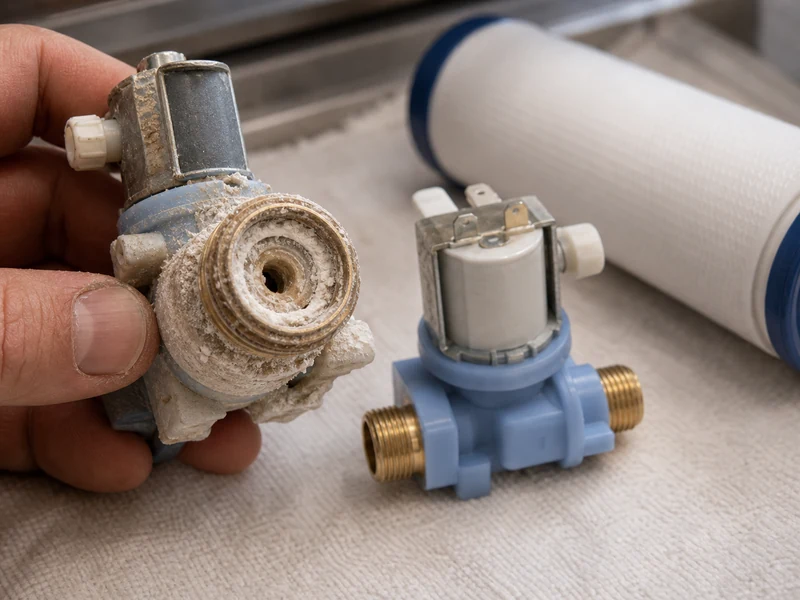
Jacksonville's JEA supply runs 14–28 grains per gallon — very hard — and scale is behind most Sub-Zero ice maker failures we see in Deerwood, Glen Kernan, and Queen's Harbour. Inlet valve, module, and filter repairs run $250–$700; we carry the parts and work weekdays 07:00–19:00.
For Sub-Zero repair across Deerwood and the Jacksonville Southside, call (904) 893-3248 or book online.
Updated June 13, 2026 · Coverage 32256 · 32224 · 32225
What 14–28 grain water does inside an ice system
The Floridan aquifer pushes its limestone through every tap on the Southside. Water hardness of 14–28 grains per gallon sits at the top of the state's range, and a Sub-Zero® ice system meters that water through some of the smallest orifices in the appliance.
Scale settles where flow slows: the inlet valve port, the valve screen, the filter cartridge, the fill tube. Each deposit narrows the path a little more, so the failure is gradual — cubes shrink, batches thin out, then the fill stops entirely. On 600-series units the electronics add their own tell, logging a fault when the ice maker solenoid stays energized beyond fifteen seconds trying to push water through a restricted port.
This page covers ice systems inside refrigeration units. The UC-15I dedicated ice machine has a different scale problem and its own undercounter service reference. Sub-Zero Repair Deerwood handles both across 32256, 32224, and 32225 — booking runs through (904) 893-3248 or the external scheduling page, and the truck stocks valves and filters for the common models.
Ice symptoms mapped to checks and budgets
| Ice symptom | Where we look first | Budget lane |
|---|---|---|
| No ice production at all | Arm/sensor state, valve power, fill test | $250–$700 |
| Small, dished, or hollow cubes | Fill volume per cycle, valve screen scale | $250–$450 |
| Cloudy or off-tasting ice | Filter age, purification cartridge, bin turnover | $250–$400 |
| Batch frozen into one block | Harvest cycle, ejector, bin thermistor | $350–$700 |
| Module cycles but never ejects | Module motor, mold heater amperage | $350–$700 |
| Ice circuit dead after an outage | Board outputs before any parts | $550–$1,100 |
A production stop that came on suddenly rather than gradually has its own decision path — start with the stopped ice maker failure-mode page before booking, because two of the causes there are owner-resettable.
Valve, module, or board — what actually gets replaced
Three components close most ice tickets, and they fail in roughly this order of frequency. The water inlet valve leads: its solenoid works hardest in hard water and its port scales first, so it is the default suspect when fill volume measures low. The ice maker module — motor, ejector, mold thermostat — comes second, typically on units past year ten. The control board comes last and is usually storm-related; a healthy valve and module with no fill command points up the harness to a board output, the same electronics covered in the blank-panel diagnostic procedure.
Dispenser-equipped side-by-sides stack a second water path on top of all of this — door valve, reservoir, dispenser solenoid — which is why the BI-42SD fault profile treats the water circuit as its own subsystem. Measuring twice matters here: replacing a module to fix a valve problem is the most common error we correct behind other companies.
Where the corridor's ice calls come from
Glen Kernan and Hampton Park generate the steadiest volume. Those kitchens were remodeled or built between 2002 and 2015, which puts their BI-series ice systems ten-plus years into service on uncorrected JEA water — squarely inside the valve wear window. The build-era math for each street is kept in the Glen Kernan community notes.
Pablo Creek Reserve calls follow the calendar instead. Households there entertain, and an ice system that limps along unnoticed in May becomes urgent the week guests arrive. The practical advice we give every owner behind that gate: if the cubes have visibly shrunk, book the valve service before the event, not after the bin runs dry mid-party. Filter cadence on this water is six months, not the printed twelve.
What the technician does on an ice-system call
Ice diagnosis is a flow problem solved with measurement, not guesswork. This is the sequence run at the cabinet, and it is built to separate a scaled valve from a tired module before any part is named.
- Confirm the basics. Arm or sensor in the run position, supply line open, filter age noted — an overdue cartridge alone shrinks the fill.
- Measure the fill. Water delivered per cycle is metered against the spec; a low fill indicts the inlet valve port or screen scale directly.
- Test the harvest. Module motor, ejector, and mold heater amperage, to tell a fill failure from a stuck harvest.
- Check the electronics. On 600-series boards a solenoid energized beyond fifteen seconds logs a fault; on BI boards we verify the ice circuit output.
- Replace and re-measure. The failed part goes in, then fill volume is re-measured per cycle and a fresh batch is run before the job closes.
The maintenance cadence that beats Jacksonville water
Most ice failures on this aquifer are preventable on a calendar rather than fixed on a repair ticket. The intervals below assume untreated 14–28 grain JEA supply; soften the water and they stretch, but the filter habit stays. Entertaining households behind the Pablo Creek Reserve and Glen Kernan gates benefit most from getting ahead of the season instead of reacting the week guests arrive.
| Task | Interval on hard water | What it prevents |
|---|---|---|
| Water filter replacement | Every 6 months | Slow fill, shrinking cubes, scale pushed to the valve |
| Inlet valve fill check | Annual | Gradual flow loss before the bin runs short |
| Bin empty and turnover review | Annual | Stale taste, clumping from slow turnover |
| Condenser cleaning | Every 6–12 months | Long run times that warm the bin and soften cubes |
| Before a known event | 2–3 weeks ahead | A dry bin mid-party, on a unit already limping |
The dedicated UC-15I ice machine scales on a freeze plate rather than a valve and keeps its own schedule on the undercounter service reference, and the community-by-community build math sits in the Glen Kernan coverage notes.
Hard-water ice questions, answered straight
- How often should a Sub-Zero water filter be changed on JEA water?
- On supply this hard, every six months. The annual habit most owners carry over from softer markets leaves the second half of the year running through a saturated cartridge, which slows the fill, shrinks the cubes, and pushes dissolved minerals toward the inlet valve. We date-label every filter we install so the next change is not a guess.
- Why do the cubes keep getting smaller month after month?
- Shrinking cubes track a shrinking fill. Scale builds gradually on the inlet valve port and screen, so each cycle delivers slightly less water than the last. The cubes go from full to dished to hollow over several months. Replacing the valve and the filter restores fill volume; we verify by measuring water delivered per cycle before closing the job.
- The ice tastes stale even though the unit works — filter or machine?
- Usually consumables, not hardware. An exhausted water filter passes taste back into the supply, the air purification cartridge stops scrubbing food odors from the compartment, and ice that sits too long absorbs whatever the cabinet holds. We replace both cartridges, dump the bin, and have you re-taste a fresh batch before treating it as a mechanical fault.
- Is descaling a worn inlet valve worthwhile, or do you replace it outright?
- We replace it. Descaling chemicals can re-open a port temporarily, but the solenoid has been working against restriction for months and its seat is usually pitted by then. A new OEM-spec valve costs little more than the labor either way and resets the wear clock, which matters on water this aggressive.
- Can the ice maker be serviced without uninstalling the built-in?
- Almost always. BI-series ice makers, valves, and fill tubes are reached from the front of the unit with panels and bin removed, and dispenser components on side-by-side models come out through the door. Full roll-outs are reserved for sealed-system work or condenser repairs, not routine ice service — relevant in kitchens where cabinetry was scribed tight to the panels.
- How many cubes should a healthy Sub-Zero ice maker produce in a day?
- A standard in-unit Sub-Zero ice maker yields roughly 2 to 4 pounds of ice per 24 hours once stabilized, which is several full harvests. On 14–28 grain JEA water that figure quietly erodes as scale narrows the fill — owners notice the bin running short before they notice smaller cubes. We measure fill volume per cycle against the spec rather than eyeballing the bin, because a 30 percent flow loss looks normal until a holiday demand exposes it.
- Why does ice form but freeze into one solid clump in the bin?
- Clumping is a harvest-and-storage problem, not a fill problem. If the bin thermistor or the harvest cycle falters, fresh cubes land warm and fuse, or slow turnover lets them sublimate and bond. On dispenser side-by-sides the auger then jams on the block. We check harvest timing, the ejector, and bin temperature before touching the water side, since a clumped bin with full-size cubes rules scale out as the cause.
- Will a whole-house water softener stop the ice maker from scaling again?
- It helps significantly but is not a license to skip filters. Softening cuts the grain count that loads the inlet valve and filter, so service intervals stretch. We still date-label and replace the cartridge, because a softener that regenerates poorly or runs out of salt sends hard water straight through. On this aquifer water, treatment plus a six-month filter habit is the combination that actually holds.
Put a Southside Sub-Zero specialist on the schedule.