Failure Mode · FM-04 · Pablo Creek Reserve · 32224
Sub-Zero Not Cooling in Pablo Creek Reserve
The gated streets off San Pablo Road built out from 2005 with PRO 48s and column pairs. That installed base is now cresting its first failure window — and "not cooling" is the call we run there most.
A Sub-Zero® that stops cooling in Pablo Creek Reserve usually has a failed fan, thermistor, or surge-damaged board — $250–$1,100 — not a dead compressor. On a PRO 48, one warm side and one cold side points to a single sealed system. We diagnose board-level behind the attended gate, weekdays 07:00–19:00; reach (904) 893-3248.
For Sub-Zero repair across Deerwood and the Jacksonville Southside, call (904) 893-3248 or book online.
Updated June 13, 2026
At a glance: a warm unit in 32224
Three answers before dispatch. Sub-Zero Repair Deerwood covers Pablo Creek Reserve and the wider Southside corridor — Deerwood, Glen Kernan, and Queen's Harbour in ZIPs 32256, 32224, and 32225. Direct line (904) 893-3248, with an external online booking page and gate details logged at booking.
What usually causes a Pablo Creek Sub-Zero to stop cooling?
On this 2005-onward installed base, the leaders are a stalled evaporator or condenser fan, a drifted thermistor, and a surge-damaged control board. All three are electrical, all three sit in the $250–$1,100 band, and none is a compressor failure.
Why does one side stay cold on a PRO 48?
Dual refrigeration. The PRO 48 runs two independent compressors and sealed systems, so a single-system fault warms one compartment while the other holds. That split tells us exactly which half to open.
How does gate access work?
The San Pablo Road gate is attended 24/7. We log your visitor authorization and guardhouse procedure at booking, so the technician clears the gate without you fielding a call mid-meeting.
Symptom, first check, and cost lane
| Symptom | First check | Cost lane |
|---|---|---|
| Fridge warm, freezer cold (BI over-under) | Evaporator fan and thermistor in the air path | $250–$1,100 |
| One side warm, one cold (PRO 48) | Isolate to the single affected sealed system | $550–$3,000 |
| Both sides warming, ran fine before a storm | Control board and surge history; check the panel state | $550–$1,100 |
| Long run times, EC50/EC40 logged | Condenser airflow before anything deeper | $250–$550 |
| Gradual warming, partial evaporator frost | Sealed-system leak or restriction | $1,500–$3,000 |
If a code is logging rather than a plain warm cabinet, the EC50 and EC40 reference walks the excessive-run causes; if the display is dark, start with the blank-panel procedure; and if the fridge is warm while the freezer stays cold with ice on the coil, that is the frost and defrost-failure pattern.
Why Pablo Creek's equipment fails on a shared clock
Pablo Creek Reserve is a Davis-developed enclave of roughly 270 homes south of J. Turner Butler Boulevard, near Mayo Clinic, behind a 24/7 attended gate. It built out from 2005, and the houses — 3,300 to 9,300 square feet — were specified at the top of the kitchen catalog: PRO 48 dual-compressor units and BI column pairs were standard, not splurges.
That shared build date is why the community now sees clustered failures. A refrigerator installed in 2007 reaches the same fan-motor and control-board fatigue window as its neighbor installed in 2008. Add the tight, flush cabinetry these kitchens favor — which chokes a condenser faster — and the Northeast Florida lightning load that stresses boards, and the corridor's largest single-model population starts retiring parts together. The fix is rarely dramatic; it is the predictable wear list of a built-in past year ten.
Community-specific access and equipment notes live on the Pablo Creek Reserve coverage page, and the PRO 48's per-side diagnostics are documented on the PRO 48 model page.
Reference data for Pablo Creek Reserve
- Build era
- From 2005; roughly 270 homes of 3,300–9,300 sq ft. Prime BI and PRO first-failure window now.
- Gate
- Attended 24/7 off San Pablo Road. Visitor authorization and guardhouse procedure logged at booking.
- Dominant equipment
- PRO 48 dual-system units and BI column pairs — the heaviest high-end installed base in the corridor.
- Set points
- 38°F refrigerator / 0°F freezer; built-ins need 24 hours to stabilize after any repair.
One honesty note specific to the newest homes here: equipment from the 2022-and-later CL, DET, and DEC generation is usually still under factory warranty, and those units belong with Factory Certified Service first. We take the out-of-warranty work, the second opinions, and the maintenance that warranty never covered.
What the technician does on arrival in 32224
A warm-cabinet call in Pablo Creek runs the same metered sequence whether the unit is a BI column or a PRO 48 — the order is built to clear the cheap, common causes before opening anything refrigerant.
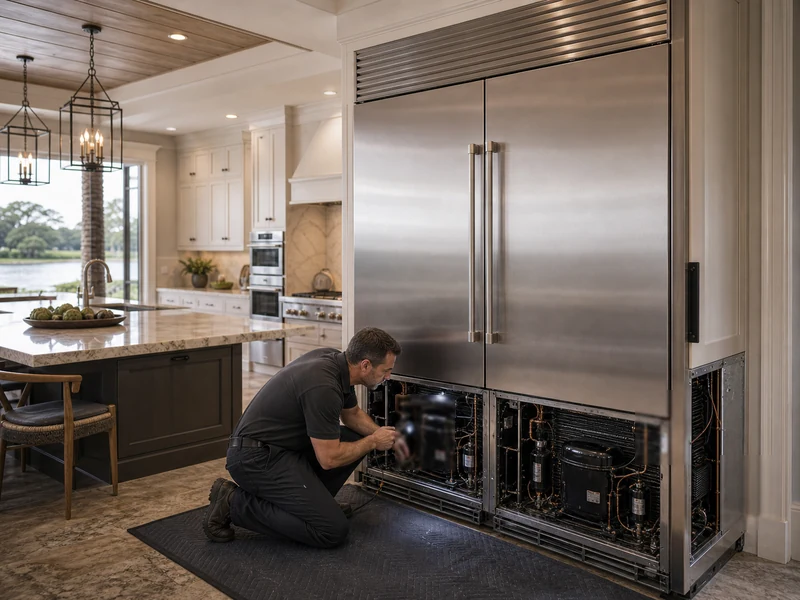
- Confirm the warm side and the set points. On a PRO 48 we note which compartment is warm — the split itself isolates one of the two sealed systems and leaves the working circuit untouched.
- Inspect and clear the condenser. The flush, tight cabinetry these kitchens favor chokes the coil first; airflow is the leading cause behind a warm cabinet here, not a dead compressor.
- Read the surge history. If the unit quit right after an outage, the board is the first suspect — the gate log often confirms the timing — and a dark panel with working lights routes to the control-board procedure.
- Meter the electrical path. Evaporator and condenser fan amperage, thermistor resistance against a reference, and board outputs separate a $400 fan from a four-figure repair.
- Read the frost pattern last. Only after the electrical side passes — even, full evaporator frost clears the sealed system; frost on the first 4–8 inches indicts it.
Electrical or sealed-system? Reading a warm cabinet
Almost every warm Pablo Creek unit is one of two things, separated by roughly $2,000. The good news is that the two announce themselves differently — speed, pattern, and the evaporator frost line decide it before any refrigerant work begins.
| Tell | Electrical (common) | Sealed system (rarer) |
|---|---|---|
| How it arrived | Suddenly — a fan, a sensor, a surge | Gradually, warming over weeks |
| Evaporator frost | Full and even, or none if the fan is dead | Only the first 4–8 inches of the coil |
| Tie to a storm | Often, via a surge-locked board | No correlation with outages |
| Typical fix | Fan, thermistor, or board | Leak repair and recharge |
| Cost lane | $250–$1,100 | $1,500–$3,000 |
On a 2005-era built-in, even the sealed-system lane favors repair — the cabinet is worth far more than the work. The PRO 48's per-side diagnostics and two-technician roll-out are documented on the PRO 48 model page, and the community coverage page carries the gate and equipment profile.
Diagnostic case notes from Pablo Creek
Educational diagnostic scenarios, not customer reviews.
Pablo Creek Reserve, PRO 48. Refrigerator side warm, freezer side holding 0°F. The single-side split pointed straight at the refrigerator system, so the freezer circuit was left undisturbed. The condenser was clean and the fault metered to a failed evaporator fan on the warm side — an electrical repair, not a sealed-system one. Verified against set points after the stabilization window.
Pablo Creek Reserve, BI column. Whole cabinet warming, owner noted it followed an afternoon storm; the gate log confirmed a brief outage. Interior lights worked, so the power path was intact — the symptom was a surge-locked board. Board replacement plus a point-of-use surge device restored cooling, with the surge note's recommendations applied so the new board would survive the next storm season.
Not-cooling questions from Pablo Creek owners
- My PRO 48 in Pablo Creek is cold on one side and warm on the other — what is that?
- That is the signature of the PRO 48 dual-refrigeration design. The unit runs two independent compressors and sealed systems, one per compartment, so a fault on a single system warms only that side while the other keeps holding temperature. It localizes the diagnosis cleanly: we open the affected side first instead of disturbing a working circuit. Cost depends on whether the fault is electrical or sealed-system.
- Why is so much Pablo Creek equipment failing around the same time?
- Because it was installed around the same time. Pablo Creek Reserve built out from 2005, and its 3,300–9,300 sq ft homes were routinely spec’d with PRO 48s and BI column pairs. That cohort is now in the 10-to-20-year window where condenser fans, inlet valves, gaskets, and control boards retire together. The community is not unlucky — it is simply reaching its first major service cycle on a synchronized clock.
- How fast can you get through the Pablo Creek gate?
- The gate off San Pablo Road is attended 24/7, so access is logged, not improvised. At booking we record the address, your name on the visitor list, and the guardhouse procedure, then send the technician’s name and vehicle ahead. Authorization clears before arrival, so the appointment starts in your kitchen rather than at the call box. Gate logistics never add to the diagnostic time.
- The whole unit went warm after a storm — is it the sealed system?
- Usually not first. Northeast Florida’s lightning load means a restoration surge is a more common cause than a refrigerant failure, and a surge takes out the control board, not the compressor. A unit that quit cooling right after an outage deserves an electrical look before a refrigeration one. If the panel is also dark, start with the blank-control-panel procedure before assuming anything expensive.
- Is a warm Sub-Zero in a newer Pablo Creek home worth repairing?
- Almost always, because the cabinet is a built-in worth far more than the repair. A 2005-era PRO 48 or BI column is a five-figure replacement once you count the integration and panels, while the common failures — fan, valve, board, gasket — land between $250 and $1,100. Even sealed-system work at $1,500–$3,000 favors repair on a unit this far from the end of its mechanical life.
- How long can a Pablo Creek PRO 48 hold temperature before food is at risk?
- A full built-in with the doors kept shut holds cold for several hours, and on a PRO 48 a single warm side does not affect the other compartment at all. The refrigerator section reaches the 40°F discard line for perishables faster than the freezer, so watch a thermometer in the fridge section rather than the panel. With same-day diagnosis on a corridor address minutes from the JTB axis, most warm units are caught well inside that window.
- Can you service two Sub-Zero units in the same Pablo Creek kitchen on one visit?
- Yes, and it is common here. The 3,300–9,300 sq ft homes routinely pair a PRO 48 with a separate column or wine unit, so one dispatch often covers several appliances. We log every model and serial at booking and load the matching parts for each, which is more efficient than separate trips through the attended San Pablo Road gate. The written findings break out each unit and its quote line by line.
- Does the dense, flush cabinetry in Pablo Creek homes cause cooling problems?
- It contributes. Built-ins set flush into tight millwork breathe through a narrow grille, so the condenser chokes on dust faster than an open install would — which is why so many warm-cabinet calls here start as a six-month-overdue coil rather than a failed part. We clean and verify airflow first, then meter the electrical side, before any talk of the sealed system.
Service pages
Put a Southside Sub-Zero specialist on the schedule.